

Forum Replies Created
-
AuthorPosts
-
The question in the exam may also use stability.
The use of the term stability or control are both correct.
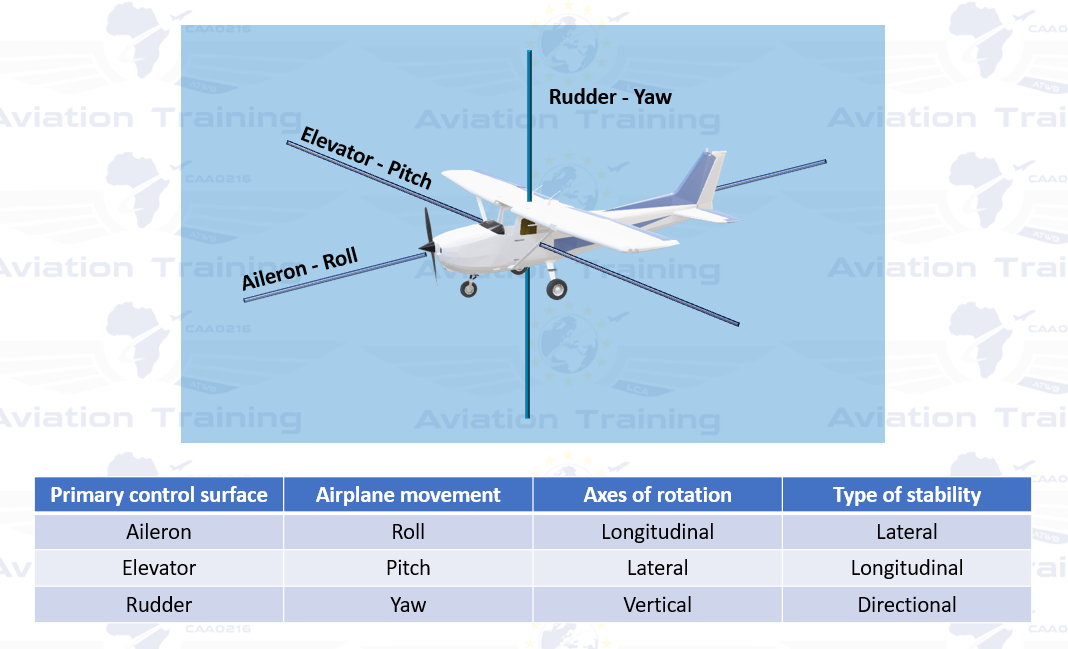
The flying control that gives longitudinal control is the Elevator. (see image and table below)
Dew point is defined as the temperature at which a given volume of air at a certain atmospheric pressure is saturated with water vapor.
So Dew point is effected by pressure. It can be calculated by working out by how much water vapor can be held in the parcel of air, vs how much water vapor is in the air, as well as what the OAT Temperature is.
If you watch the video on slide 5 and see the image slide 7 – (Thermodynamics – Aviation Training CBT (atcbt.com)
-
This reply was modified 4 years, 10 months ago by
Louise Hahn.
You would have to look at the image and then based on the scale of the chart you would roughly work it out how far it would move, by working out the distance from the front to in this case Cape Town.
Then using the speed, distance and Time formula you can work out how long it would take.
- Cold fronts generally advance at average speeds of 20 to 25 mph.
- Warm fronts usually move about half as fast, at about 10 to 15 mph, and sometimes even slower.
P-MET-AP-0018
An aircraft flies from aerodrome “A”, where QNH is given as 1020Hpa, to aerodrome “B”, where the QNH is given as 999Hpa. Aerodrome “A” is 800ft above mean sea level and aerodrome “B” is 500ft above mean sea level. If the altimeter sub scale is not changed from 1020, what is the altimeter indication on landing? (ASSUME 1hPa = 30ft)
We can work this out exactly the same way that you would pressure altitude, except we would use 1020 instead of 1013
- Airfield elevation + ((1020-999) X 30)
- 500 + (630) = 1130ft
P-MET-ALT-0004
If the elevation is 900ft, the QNH is 998. OAT is -7 What is the Density Altitude?
Step 1: Work out the Pressure Altitude
- Pressure Altitude = Elevation + ((1013 – QHN) X 30)
- Pressure Altitude = 900 + ((1013 – 999) X 30)
- Pressure Altitude = 1320ft
Step 2: Work out the ISA Temperature at the airfield elevation
- ISA Temp = 15 – ((Elevation/1000) x2)
- ISA Temp = 15 – ((900/1000) x2)
- ISA Temp = 13.2C
Step 3: Work out the ISA Dev and apply 120ft per degree C
- ISA temp = 13.2C
- OAT = -7
- ISA DEV = -20.2C
- -20.2 X 120 = – 2424
Step 4: Apply the calculation from step 4 to pressure altitude, as it the ISA DEV is – we will subtract it
- 1320 – 2424 = -1104ft
-
This reply was modified 4 years, 10 months ago by
The motor applies torque, which then precesses the gyro around the vertical axis and rotates the data selsyn rotor, attached to the Gyro Magnetic Compass drive shaft.
Hi Yaseen,
This image shows the ball in the centre and the wings level, which means that the T&S is balanced. This image indicated that you are flying straight and level
-
This reply was modified 4 years, 10 months ago by
-
AuthorPosts
